On Tuesday, the European Environment Agency released three new reports on the state of the circular economy in Europe. The timing was deliberate. The EU Circular Economy Act is expected later this year, and the EEA is building the evidence base ahead of it.
The headline finding covers 17 specific circular economy actions, modelled across sectors including housing, food, mobility, and mining. If implemented together, those 17 actions could reduce Europe’s contribution to climate change by 22 percent, which the EEA calculates as close to one billion tonnes of CO2 equivalents. Biodiversity loss would fall by 19 percent. Fine particulate air pollution would drop by 25 percent.
These are not projections built on optimistic assumptions. They are derived from sector-level modelling of concrete interventions, each with a defined mechanism and a measurable output.
The resource dependency argument
Beyond the environmental case, the EEA framed circularity as a supply security issue. Europe imports large volumes of raw materials, and the extraction of those materials puts pressure on ecosystems elsewhere in the world. The assessments found that implementing the 17 actions would reduce EU reliance on aluminium, nickel, and platinum group metals from other regions by around 20 percent, and copper dependency by 12 percent.
For a continent that imports nearly all of its heavy rare earth elements, the majority from China, that reduction carries obvious strategic weight. This is not an environmental argument dressed up as an economic one. It is a material security argument with numbers attached.
An investment gap of 82 billion euros per year
The second of the three reports, titled “Unlocking the circular economy: investment needs, barriers and enabling conditions,” addresses where the money is not going. The EEA calculated an investment gap of around 82 billion euros per year up to 2040, measured against the objectives of circular economy policies already adopted and in force.
The sectors with the largest gaps are construction, textiles, and batteries and vehicles. Private finance currently dominates circular investment, but the report argues that public funding plays a structurally important role. Without it, many circular projects cannot reach the risk profile that private investors require.
Buildings as a resource bank
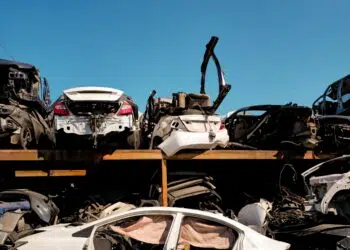
The third report examines what the EEA calls material stocks: the enormous quantity of materials embedded in long-lived products. In Europe, each person consumes 14.4 tonnes of materials per year. Over six tonnes of that ends up locked inside buildings, roads, cars, and industrial machinery.
The report argues that this accumulated stock should be treated as a future source of secondary raw materials. Better design, longer product lifetimes, and higher recovery rates at end of life would turn what is currently a resource sink into a supply asset. The EEA describes this as one of the least exploited opportunities in the European economy.
What comes next?
The three assessments are part of a larger series the EEA is producing through 2026, timed to support the incoming Circular Economy Act. The figures now exist. The question of whether European investment follows them is a separate matter entirely.