Japan is a country that puts the care of society first. From an early age, children are taught the importance of cooperation, respect for others and attention to the needs of every member of the community. These values present themselves tangibly in the urban environment and in the way life is organized, with the goal that no one is excluded or ignored.
In public transport
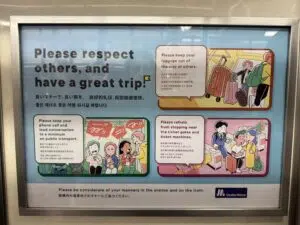
Public transport in Japan’s major cities is organized in a way that is understandable to people with all kinds of sensory perceptions and cognitive abilities. Subway lines, for example, have names in addition to a distinctive color, and each stop is numbered. For people who are visually impaired, each station has a unique sound that resembles a short song that is somehow related to the place. Pedestrian traffic lights also have a specific sound. Depending on whether the direction is north-south or east-west, the sound made at a green traffic light is different.
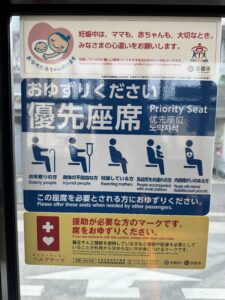
In public transport, the signs indicating that certain seats are for priority accommodation of pregnant women, parents with small children, elderly people, people who have limited mobility, but also people who have invisible disabilities. Such passengers should wear a badge with a special symbol, with a visual of a cross and a heart, and the signs encourage people to give up their seat to a person with such a badge. The signs state that not all disabilities are easily visible, so people with such a badge may need extra support. Such “invisible” disabilities may be the use of medical devices such as pacemakers, prostheses, or chronic pain conditions.
In urban environments
To support disabled people to move around independently, Japan uses more than just visual and audible cues. Tactile tiles, known as ‘tile block’, are often found on pavements and in public buildings. These special pavements with embossed dots and dashes serve as a tactile guide for the visually impaired. They warn of potential hazards such as stairs or walkways, and at the same time indicate the safe direction of travel.
In Japan, the needs of parents have also been addressed: both men’s and women’s public toilets are equipped with changing tables and wall-mounted child seats. This practical measure greatly facilitates the care of young children in public spaces.
On the plane
One of the airlines that carries passengers to Japan, Turkish Airlines, has also developed a special safety video for disabled passengers. The company demonstrates its commitment to all its passengers by addressing them in a way that excludes no one: “Ladies and gentlemen, dear children”. This is a small but significant detail that shows respect and consideration for diversity among travellers.
Japan’s inclusive approach can serve as a valuable lesson for many other countries. It shows that with careful planning, investment in accessible infrastructure and cultivating empathy, it is possible to create a society where everyone feels valued and can participate fully.