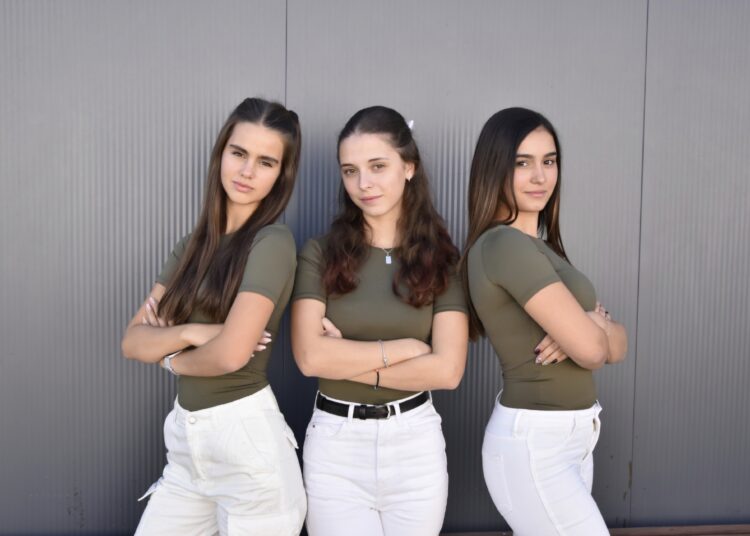
Three young female entrepreneurs, Sofia Nikolova, Victoria Koleva and Alexandra Klyaneva, in their last year at the “Prof. Ivan Apostolov” high school, started BioBliss as a student company, driven by their common goal and aspiration for sustainability, green entrepreneurship and finding an affordable solution to a global problem.
Initially, they focused on the idea of recycling batteries, but quickly realized that many companies were already working in this direction. They discovered that the real problem was not only in the recycling of waste, but in the production itself – in the materials and resources that are used.
Therefore, the creators of BioBliss asked themselves if there was a way to completely eliminate the need for such harmful lithium in batteries. And then they asked themselves the question: “Can’t we create our own, more sustainable batteries?” – and the answer is a big “YES”.
Here’s what they told ESGnews.bg:
Girls, tell us why you chose biowaste as a source for batteries?
We chose biowaste as a source for our batteries because in this way we support the circular economy – instead of being thrown away, they get a new life as a valuable raw material. Biowaste is a practically inexhaustible resource, rich in carbon – a key element for our technology, which provides us with a sustainable and safe basis for production.
During our research, we found that the biggest problem with lithium-ion batteries lies in their production itself and the use of harmful raw materials such as lithium. That is why we decided to look for an alternative for this component, instead of limiting ourselves to recycling.
In this way, we manage to combine two directions: on the one hand, we completely eliminate the need for lithium, and on the other – we provide a solution in the field of waste management, because instead of biowaste being thrown away or burned, we give it a new life. In this way, we create a technology that is both environmentally friendly, sustainable, and applicable on a large scale.
What kind of biowaste do you use to make the batteries?
Our prototype was created from coffee, as it is extremely rich in carbon and at the same time it is the second most popular drink in the world, which makes coffee grounds one of the most common biowaste.
In practice, we can use different types of biowaste, as we are currently conducting tests with PET-based plastic. The reason is that this type of plastic is one of the most common and at the same time the most harmful waste – it is used massively to make water bottles and is thrown away daily in huge quantities, polluting nature and decomposing for hundreds of years.
If we manage to achieve the necessary results, this will not only be a technological breakthrough for our battery, but also a huge step forward in the fight against plastic pollution.
What makes your batteries different from conventional ones?
Our batteries differ from conventional ones mainly in that we do not use lithium as an anode. Instead, we apply a process that is significantly easier and much more environmentally friendly. Thanks to the high efficiency of the technology and the abundance of biowaste as a raw material, we can offer a product that is up to three times cheaper than standard batteries, without compromising on quality.
Where is the greatest potential for battery applications?
Our technology can be applied to any static battery, and with minimal changes to the other components we can adapt it to the specific type. This means that in addition to button batteries, which we already use for watches and remotes, we can also produce the most popular formats – AA and AAA, and in the future even batteries for phones and laptops.
This makes our technology fully scalable – we can start from small formats and gradually enter larger segments. In addition, the market for AA and AAA batteries exceeds billions of units per year, which opens up huge potential for growth and real impact.
What were the biggest difficulties you faced in implementing the project?
The biggest difficulty at the beginning was that our work was based on the “trial and error” method – we did a lot of tests until we found the right “recipe”, and only for one type of biowaste. We know that we still have a lot of work to do to expand the application of the technology.
We have also sometimes encountered our age as an obstacle, as it is often perceived as a lack of experience, but in fact this is our greatest advantage. It gives us the freedom to think outside the box, to be bold and creative, without being afraid to try new things.
We have energy, enthusiasm and perseverance, which help us turn difficulties into opportunities. This is what allowed us to get this far and what motivates us to move forward. Today we are facing the biggest challenge – to turn our idea into a real working business. We fully realize the seriousness of the task, but we are confident that with teamwork and perseverance we will succeed.
How has the experience you have gained changed the way you look at sustainability?
The experience we have gained has changed the way we look at sustainability. At first, we perceived it more simply – to recycle, to use less plastic, to be “eco”. However, over time, we have understood that sustainability is much more – it is not just the gesture of throwing a bottle in the container, but what actually happens to it afterwards. The real meaning is in the whole process – what we produce, how we use it and what consequences we leave. This experience has made us more aware, because we have understood that sustainability is not a fashion, but a necessity that requires responsibility and long-term thinking.
What is the next level for BioBliss?
The next level for BioBliss is related to our transition from a startup to a real business with sustainable development. We are currently in the process of registering a company, which is a key step for our professional growth. In parallel, we are actively participating in two accelerator programs – the EIT Jumpstarter program and the SCION accelerator. They provide us not only with knowledge and mentoring support, but also with access to contacts that are extremely valuable for building our future business model.
With their help, we hope to realize our main goal at this stage – to establish a production base for our batteries. This will allow us to launch pilot production, test the product in a real market environment and take the first decisive step towards entering the market. We believe that this transition – from idea to production and implementation – is the most important step in showing that our technology can be sustainable, affordable and applicable on a large scale.