
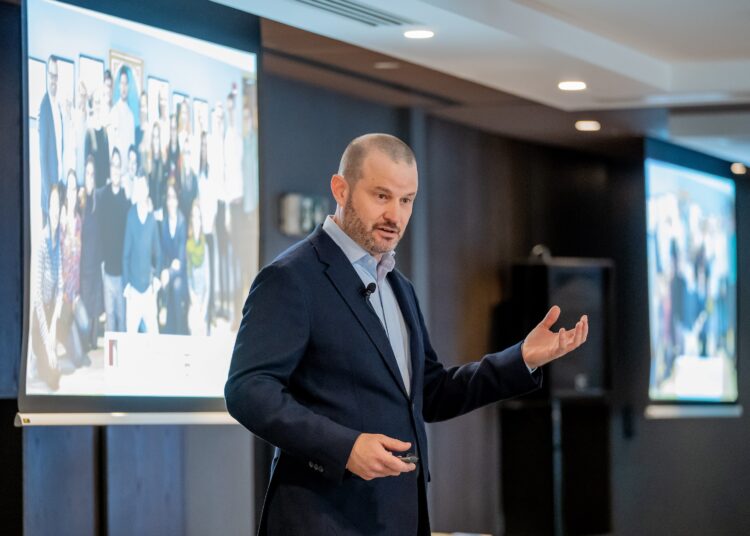
Dr. James Gifford is widely recognized as one of the primary architects of the global ESG investment movement. In 2004, he was part of the team at the United Nations that coined the term “ESG” and then served as the founding Executive Director of the UN Principles for Responsible Investment (PRI) until 2013. Under his leadership, the PRI grew from a concept into a global standard currently signed by institutions managing over $120 trillion.
He is currently a Senior Fellow at the University of St. Gallen’s Centre for Sustainable Finance and Private Wealth (CSP), where he co-founded the flagship “Impact Investing for the Next Generation” program in collaboration with MIT Sloan. We spoke to Dr. Gifford last week when he was in Sofia for the II-nd National Forum for Sustainable Business Transformation, hosted by the Family Business Network (FBN) Bulgaria. He was here to lead a workshop on “Sustainable Family Growth,” providing Bulgarian family businesses with the tools to transition from traditional asset management to high-impact portfolios.
Dr. Gifford, as the founding Executive Director of the UN Principles for Responsible Investment (PRI), you were part of the original UN team the initiative that coined “ESG” as a term back in 2004. Looking at the landscape today in 2026, has the movement evolved into what you originally envisioned, or has the focus on ‘regulatory compliance’ overshadowed the original goal of ‘real-world impact’?
I think the ESG movement has achieved a lot, despite the more recent backlash. When we launched the PRI, there were perhaps a few hundred people globally focused on this topic. It was a very small industry. The two largest ESG data providers had less than 50 people each. Today, there are literally tens of thousands of people working to pursue ESG goals – and that’s just in the investment side of things. If you could corporate sustainability, it would be in the hundreds of thousands, if not a million.
However, it is true that it has shifted from an entrepreneurial, innovation mindset to a compliance, box-ticking mindset, and much of the EU regulation hasn’t really helped. The focus from regulators is less on real impact and more on disclosures, reporting and processes. But the industry overall I think has caused many companies to think much more about their negative impacts, and reduce them where they can, which is a good thing.
You were in Bulgaria to speak at the II-nd National Forum for Sustainable Business Transformation, organized by FBN Bulgaria. The theme this year was ‘Sustainable Family Growth.’ For family business owners in Bulgaria, does impact investing serve as a ‘bridge’ between the values of the older generation and the ambitions of the next generation of leaders?
Yes, impact investing can absolutely serve as this bridge. At the Centre for Sustainable Finance and Private Wealth (CSP), we have been teaching UHNW family members for 11 years and many of our next gen participants leverage impact investing to build their investing skills, diversify the family’s domain expertise and seek to bring different branches of the family together to invest. Because impact investing is really a global movement (thought it obviously has local implementations) it provides great opportunities for business owners in Bulgaria to give their adult children global investment experience – and can also provide a pathway to new innovation for the businesses themselves.
In your recent work at the University of St. Gallen, you emphasize the ‘five dimensions’ of real impact. what is the single most important question to ask a company to determine if their impact is ‘additional’—meaning it wouldn’t have happened without their specific investment?
The most important question when evaluating a company from an impact perspective is whether it (1) has a genuinely impactful product that adds value to the market and (2) whether it is likely to get investment from someone else anyway, in which case it doesn’t need your money. But there is a paradox, the companies that are too obviously profitable will get funding from anywhere. so there is no additionality. But the companies that are obviously not profitable will fail, and you’ll also generate no impact. So to be a good impact investor, you need to find companies that have a genuine shot at succeeding, but where they really need your investment. In these cases, you can both make money and deliver impact.
Greenwashing has become more sophisticated over the last two decades. In your workshop, you provide a practical guide to spotting ‘pretenders.’ What are the red flags in a corporate sustainability report that still consistently trick even experienced private investors today?
In investment, if a fund is claiming impact but is just investing in listed equities, and not being an active owner (shareholder engagement, filing shareholder resolutions, etc.) then it is unlikely to be impactful. They are just buying shares from someone else in a highly liquid market. Money and shares change hands, but nothing changes in the real world. If you want real impact, you have to fund companies in the private markets, that is, venture capital, private equity, private debt, etc. In these asset classes, the money is doing directly to the company, facilitating their growth.
During your time at the UN and later in the private sector, you’ve seen capital flow toward the ‘next frontiers.’ Where do you see the most exciting intersection of innovation and impact right now? Is it in climate tech, circular economy models, or perhaps something more niche like regenerative agriculture?
I think there has been a lot of investment into climate tech, and much of this won’t deliver strong returns. Arguably, climate tech in 2021 was too optimistic, and a combination of high interest rates, geopolitical instability and the policies of the US Government have created real headwinds. However, there are parts of the energy system that have a very strong business case and that includes grid stability (to cope with the huge build out of renewables) such as batteries and transmission lines, and clean baseload energy sources such as nuclear and geothemal. Healthcare and biotech, while they still have their ups the downs, will continue to have strong growth as people get richer and live longer. And, of course, AI will play a large role in every part of the economy, including helping to solve our greatest societal challenges.
You’ve seen the ‘First Wave’ of ESG at the UN and the ‘Second Wave’ of data and regulation. What does the ‘Third Wave’ look like? Do you believe we are heading toward a future where the distinction between ‘investing’ and ‘impact’ disappears entirely?
I’m hoping that the sustainable and impact investing sector jumps on board the “abundance” agenda, which was laid out well in the book of that name by New Your Times writer Ezra Klein. Rather than thinking of environmental challenges as restrictions that hold us back from fulfilling our genuine human desire for flourishing, we need to lean in on innovation, and invest in moonshots to solve our greatest challenges through invention. I don’t know if that’s the direction of the industry, but that’s where I’d like to see things head.