
Singapore has long surpassed its status as an economic miracle, evolving into a global benchmark for sustainable development. This city-state in Southeast Asia offers profound inspiration for environmental practitioners, along with actionable lessons in social and governance factors that can be adapted on a global scale.
Environment: A City in Nature
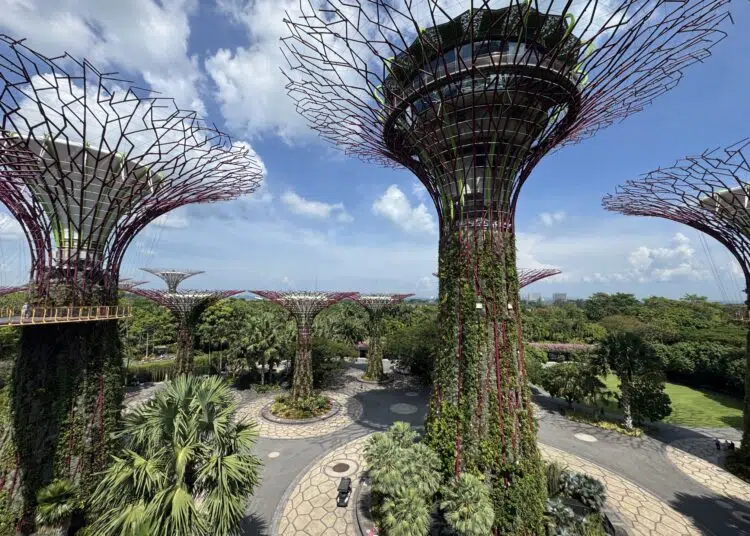
Singapore is undoubtedly one of the greenest metropolises in the world, yet this is not a result of mere natural occurrence but of decades of deliberate effort. The “City in Nature” concept is integrated into every facet of urban planning. A striking example of these sustainability efforts is materialized in iconic projects like Gardens by the Bay. These vertical gardens are more than just a tourist attraction; they are a complex ecosystem that collects rainwater, generates solar energy, and regulates the temperature of the surrounding spaces.
Here, energy efficiency is a reality achieved through cogeneration. On-site, carbon-neutral electricity is produced by a steam turbine fueled by wood and horticultural waste collected from across the city. This process not only reduces dependency on fossil fuels but also allows for the capture of waste heat. Eleven of the iconic Supertrees are equipped with photovoltaic cells to harvest solar energy for their lighting, while others serve as air exhaust receptacles for the complex’s cooling systems.
Social Factors: Compassionate Design
In Singapore, as in many other developed nations, the population is aging at an accelerated pace. What sets it apart is the comprehensive and innovative care for the elderly, woven into the very fabric of society. One of the most impressive examples is the “Dementia Go-To Points” initiative located at key transit hubs like metro stations. These are safe zones where trained staff assist individuals with dementia who may have become lost or disoriented, providing a secure environment until their families arrive.
Social policy is further bolstered by practical technological solutions. Every retiree holds a specialized card providing access to subsidized public transport, preferential healthcare, free library resources, and a vast network of commercial discounts. The card is an example of inclusivity in action. Furthermore, it allows seniors to tap a reader at pedestrian crossings to receive 10 additional seconds of green light, ensuring they can cross busy streets with safety and peace of mind.
Governance: Vision and Strategic Foresight
Singapore’s governance model is built on transparency and the rigorous application of regulations, creating a predictable environment for investors. The city impresses with its exceptional long-term planning, specifically through the “Singapore Green Plan 2030.” The government has set measurable targets: planting an additional one million trees, reducing waste sent to landfills by 30%, and ensuring at least 20% of schools are carbon-neutral by 2030.
Singapore demonstrates how urbanization and nature can coexist in symbiosis by utilizing vertical greenery to combat the urban heat island effect. The city actively invests in water recycling technologies and waste management, proving that limited resources can be a catalyst for innovation. The lesson from Singapore is clear: a sustainable future requires bold leadership that prioritizes the public good and ecological balance over short-term economic gains. Thus, the city has become a laboratory for the future, where governance serves as the primary engine for positive change.